red list
Scholars with interests in endangered species conservation and environmental justice reflect on how an organism comes under consideration for special protections of its livelihood. A “red list” emphasizes rank and status, raising questions about who counts, and why, and what it means to be included in a protected community.
red list
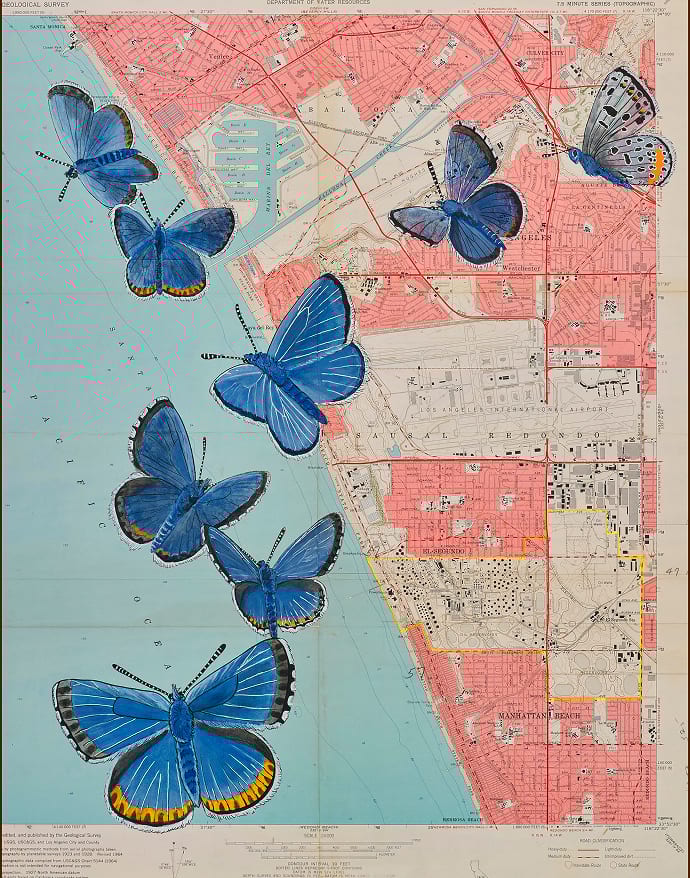
A blue-gray glint of gossamer light that appears and is extinguished within the span of a week or two, the tiny El Segundo blue butterfly (Euphilotes battoides allyni) seems the very emblem of ephemerality. Endemic to a small dune ecosystem on the Southern California coast, this butterfly rarely travels more than 200 meters on fragments of its remaining habitat. At preserves that dot the coastline, the butterfly lives out its brief life often within the confines of chain-link and barbed-wire fences installed on some of the most intensely developed and industrialized sites in California. There it shares airspace with one of the world’s busiest airports and ground space with one of the largest West Coast oil refineries: Los Angeles International Airport (LAX) and Chevron.
No larger than a thumbnail, the El Segundo blue is seldom seen or celebrated beyond its limited range. A visitor might scan a field of flowering buckwheat—the butterfly’s preferred host plant—for hours during the insect’s peak season of activity and never manage to catch a glimpse. Small honeybees, who also relish the buckwheat’s nectar, are far easier to spot. Like other creatures bound to an obligate host, the El Segundo Blue is utterly dependent upon a single plant called seacliff buckwheat (Eriogonum parvifolium) that is native to these scraps of sandy seaward bluffs. Unlike other butterflies who form intimate bonds with plants, the El Segundo blue’s dependence on the flowerhead of its host plant is virtually complete—involving every stage of its development from egg to adult butterfly. As the insect larvae mature, they secrete a honeylike substance that attracts ants. This secretion creates a symbiotic relationship: the ants tend the larvae and protect them from predators and parasites.
Female of the species who is more grey-brown than blue. The female’s drabber colors make it less conspicuous to predators.
The butterfly was first formally described in 1975 based on specimens found on the sprawling Chevron oil refinery in El Segundo, California. Within a year, it was listed as federally endangered, and it became one of the first invertebrate species to receive such designation under the federal Endangered Species Act (ESA), which was only two years old at the time. The El Segundo blue has longstanding ties to oil and to modern petrocultures enabled by oil extraction. Over the course of the twentieth century, the butterfly was drawn into a complex relationship with extractive industries that, for humans, allow the freedom of long-distance travel and define a global existence. The species’ survival prospects directly enlist the cooperation, voluntary or otherwise, of the very industries and lifeways that simultaneously drive climate change, habitat loss, and species decline.
According to the red list compiled by the International Union for Conservation of Nature (IUCN), more than 45,300 species are at risk of extinction. IUCN is headquartered in Gland, Switzerland, with offices around the world. Its membership consists of both government and civil society organizations, and diverse stakeholders. The IUCNred list was launched in 1964 but the vast majority of the planet’s described species have yet to be assessed. While the IUCN red list famously functions as a “barometer of life,” a powerful tool to guide conservation priorities and assesses extinction risk, it lacks legally binding power. The red list is not a legally enforceable document, but researchers, the media, zoos and conservation organizations are more likely to study and share data about species that appear on the list.
Practices surrounding red listing can be opaque and somewhat bewildering to the nonspecialist. Red lists comprise an incomplete patchwork of inventories at the international, federal, and state level. Considerations that ultimately land a particular species on a red list are complex and imperfect; small invertebrate species are far more likely to be overlooked. Only a subset of species that are red listed by the IUCN also appear under the Endangered Species Act which essentially functions as a red list at the federal level. For insects, that subset amounts to an astonishingly low 20 percent. Individual states, meanwhile, compile red lists in keeping with their own ESA legislation.
While the El Segundo blue appears on the federal endangered species list, it is not currently protected under the state ESA of California even though the butterfly exists nowhere else in the world. Indeed, until 2022, the state of California ESA was completely silent on the protection of insects, including four species of native bumblebees that are essential pollinators of the state’s primary agricultural crops. In an interesting twist that underscores the arcane and often ad hoc nature of red listing, these honeybees were granted protection by means of a creative legal interpretation that classifies them as fish.
Various agencies and activist groups have stepped up to fill the gaps left by patchy legislation and protections. The Xerces Society, whose mission is the protection of invertebrates and especially butterflies, created its own red list of pollinating insects in 2005.That document assessed the El Segundo blue as critically imperiled, but it has not been updated since 2007. As it currently stands, then, the El Segundo blue owes whatever legal protection it enjoys to the federal ESA supplemented by robust volunteer conservation efforts.
Inadequacies and inconsistencies in red listing, and the complex legal tangles that leave some at-risk species vulnerable, might also be addressed by formal and informal efforts to think more creatively about the range of values nonhuman creatures bring to human contexts and communities, particularly at the local level. Movements to recognize the cultural, spiritual, and psycho-social significance of species have led ethnobotanists, anthropologists, and other researchers to develop the Cultural Keystone Species framework (CKS). CKS attends to “culturally salient species that shape in a major way the cultural identity of a people, as reflected in the fundamental roles these species have in diet, materials, medicine, and/or spiritual practices.”
The CKS is a counterpart to the keystone species concept in ecology. The latter concept denotes species that come to define an entire ecosystem by exerting disproportionate influence on other creatures within the biotic community. The CKS framework addresses biodiversity loss by promoting a “biocultural” stewardship approach that emphasizes the interdependence and coevolution of biological and cultural diversity. This approach encourages community members whose lives and cultural identity intersect with the species in question to feel more included in conservation efforts and more motivated to care. In particular, a CKS framework helps to convey respect for traditional ecological practices and knowledge of Indigenous communities.
Though the practice is not widespread as pertains to small invertebrate species like the El Segundo blue, some ethnobiologists have made a case for considering certain insects, like butterflies and moths (Lepidoptera), as Cultural Keystone Species. In Australian Aboriginal cultures, for example, some honeybees and moths, along with their larvae, are “highly prized” for their roles in traditional songs and ceremonies, medicinal practices, creation stories, as well as place names and personal names. While the CKS approach might seem to foreground human perspectives, as indeed value frameworks that inform species protection often do, it has the power to capture values that emerge in the relational interstices of human-nonhuman encounters. These interstices are where meaning-making and intimations of the sacred erupt. Butterflies display many features of a cultural keystone species. Across many cultures, Lepidoptera carry religious and spiritual meanings as avatars of the soul, symbols of profound transformation and resurrection, owing to their capacity to radically remake themselves through a series of developmental feats that turn an ordinary caterpillar into a winged fairy-like creature. The spiritual significance of butterflies also makes them ready symbols of freedom, flight, mobility, and escape, and similar values and aspirations are enshrined in our modern fossil-fueled existence. Yet the particular features of the El Segundo blue’s existence—its hyper-local ties to a small, highly specific habitat, its humble place-making practices—might suggest a different example. This tiniest of creatures presents a spiritual test for oil-addicted humans. The El Segundo blue butterfly offers a symbol of resistance to the extractivist juggernaut that, paradoxically, both threatens and sustains its survival.